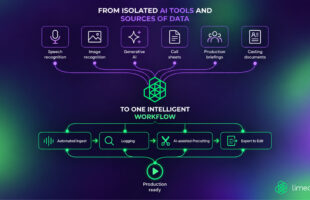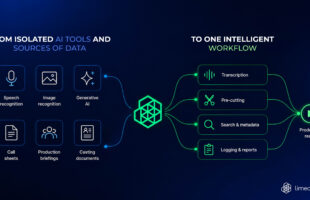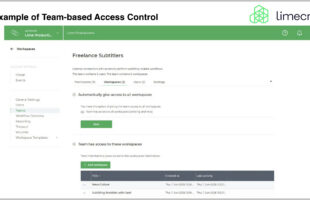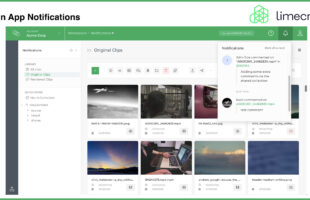


Limecraft today announces version 2026.7 of its cloud-based media production and delivery platform, introducing a Workflow Library, expanded AI-assisted transcript clean-up, and more flexible enterprise subscriptions. This release also enhances custom branding and content delivery workflows, giving media organisations greater control over recurring operational tasks and resource consumption. The new capabilities will be demonstrated at SATIS 2026, taking place on 4 and 5 November at Les Docks de Paris.

“Efficiency gains come from addressing the work that people repeat every day,” comments Maarten Verwaest, co-founder of Limecraft. “Applying retention rules, cleaning up transcripts and adjusting capacity to a production schedule all consume time. With this release, we are making those processes easier to automate and control within the same connected media environment.”
Build repeatable processes with the Workflow Library
The new Workflow Library introduces a foundation for configuring and reusing standard media workflows. Its first application is automated media purging, allowing administrators to remove selected media versions according to retention periods and other filters. Account and Workspace administrators can configure workflows through Workspace Settings, define the material and media versions affected, and enable scheduled or manually triggered execution. This helps organisations apply retention policies consistently and manage storage consumption with less manual intervention. The library forms part of Limecraft’s broader investment in configurable automation. Further releases will progressively extend its capabilities across material lifecycle management, AI enrichment and media processing.
Reducing manual subtitle post-editing work in 17 languages
Limecraft 2026.7 expands disfluency filtering with an extra 17 languages, including Dutch, French, German, Greek, Italian, Portuguese and Spanish. Na a focused AI agent lc the transcription workflow, disfluency filtering removes filler words, hesitations, and unnecessary repetitions. This produces cleaner text before Limecraft’s configurable spotting rules convert the transcript into subtitles. For subtitling and localisation professionals, cleaning the transcript at this stage reduces repetitive post-editing and avoids carrying unnecessary text into individual subtitle cues. Editors retain control over meaning, terminology and the final result.
Matching enterprise capacity to production demand
The new Enterprise FLEX subscription plan combines Limecraft’s enterprise capabilities with adjustable allocations for Cloud Storage, Ingested Media and Managed Media. Authorised users can add capacity blocks as demand increases and reduce their commitments for subsequent billing periods. A temporary upgrade option provides additional capacity specifically for the current billing period, supporting production peaks without creating an ongoing allocation.
Improved content intake and review
Delivery Workspaces now support drag-and-drop uploads. Request templates can require, allow or omit comments separately for submission, approval, rejection and archiving, enabling organisations to capture feedback where it is needed. Further refinements make reviewer responsibilities clearer, simplify request navigation and improve validation messages.
Across the platform, release 2026.7 also strengthens browser-upload resilience, preserves navigation context, and extends multicam compatibility with existing production metadata.