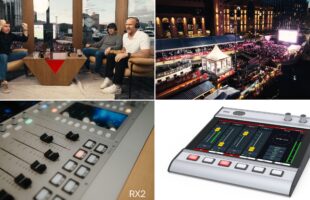


dhd.audio reports a high level of interest in its range of audio production equipment on all four days of the September 11-14 International Broadcasting Convention in Amsterdam. Centre of attraction on the DHD stand this year was the new MX3 control console.

Celebrating the 30th anniversary of its foundation, DHD has long experience in designing modular audio mixers which separate the control surface and the audio processing cores into independent modules. Control surfaces in one or more studios connect to a processing core located in a local or remote apparatus room. This approach offers a high level of operational versatility as the control surface becomes a compact and power-efficient touchpoint rather than housing the complete system. It also offers all the advantages of modern IP networks: flexible routing, power over Ethernet, and easy system pairing. For example, a single studio can take control of multiple processing cores at a time or switch between them, with the processors remaining on air 24/7. Systems can be expanded or reduced in size simply by adjusting the configuration. Distributed sites can run on the same architecture as the flagship facility.
The DHD MX3 extends this flexibility. Each MX3 module is a self-contained network device which links via Ethernet along a single cable per console column. MX3 consoles can be specified from a range of modular elements, typically a central module plus six-fader expansion modules.
Audio-over-IP has long been a central aspect of DHD’s Series 52 range, including compatibility with AES67/Ravenna, Dante, and SMPTE 2110 protocols to handle very large channel capacities. MX3 retains that versatility, supplemented by secure standard IP networking between desktop control panels and local or remote signal processing cores; this replaces the DHD APC (audio/power/control) protocol used in current Series 52 systems.
MX3 modules can be housed in a frame with optional over-bridge modules, plus optional displays mounted above the over-bridge. Modules may be added, exchanged, or repaired if or whenever required. Assignment between console and processing core is guided by a simple principle: what you see is what you control. Displays throughout the surface show what the adjacent controls currently do, following the selected view.
“DHD products are built to last, but that does not mean staying the same forever,” summarises Marc Herrmann, Managing Director. “It means lasting through logical and economically efficient change. The best systems adapt over time through upgraded software or by exchanging single components of the networked system to match new requirements and standards; never everything at once. We build systems that grow with their users over time. Built to last means built to change.”
Also demonstrated at IBC were control consoles from DHD’s established Series 52 range running latest-generation 10.4 firmware, plus the new Discovery tray app, Routing App and MIDI App. AI-based audio noise reduction also made its IBC debut as a purchasable option for XD3 Quad Core processors. Developed by ai-coustics, this utility helps reduce background distractions in voice channels such as sports commentaries, or traffic noise from outdoor news reports. The process repairs audio signals rather than replicates voices and so preserves each speaker’s natural identity and timbre. Processing intensity is easily adjustable. Up to three stereo instances can operate in parallel on a single XD3 core.